 David Meltzer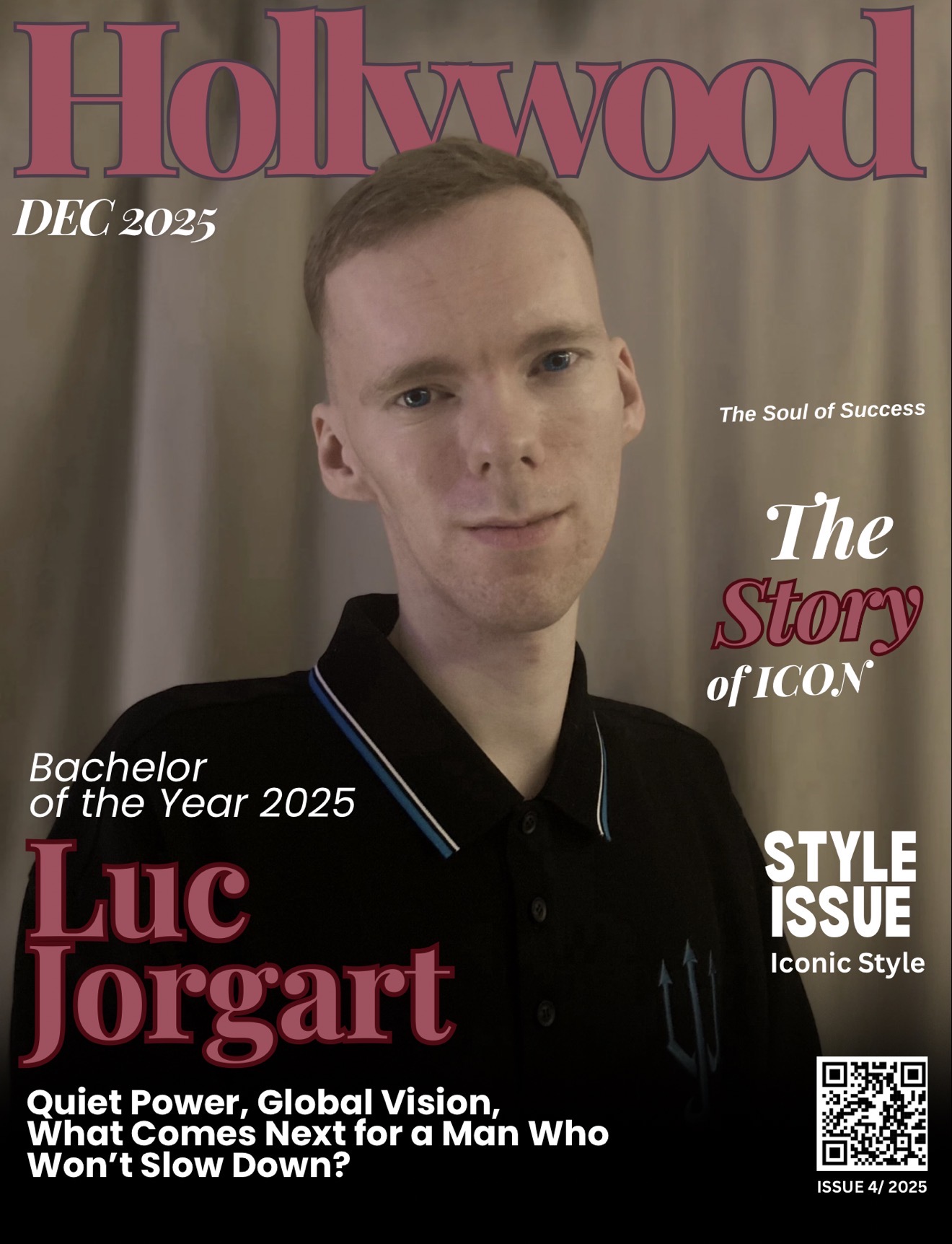
“I have a thousand dreams and only one life to realise them all. So, I live adventurously and dream without limits”
When the Hollywood Times editorial board gathered to select our Bachelor of the Year, we expected the conversation to circle familiar territory — rising actors, chart-topping musicians, and social media titans whose faces define the cultural moment. But, someone entirely different — and far more intriguing — kept coming up in the room: Luc Jorgart, a British legal scholar, novelist, and creative force whose quiet charisma and global perspective captured our attention long before he stepped into the spotlight.
What makes Jorgart stand out is not just his presence — though his calm confidence and striking look certainly turned heads — but the multidimensional life behind it. He is a man shaped by intellect and ambition, by resilience and reinvention, by a journey that stretches from London to Tokyo, threading together legal scholarship, fiction writing, philosophical reflection, and early experiences in film & TV. In an age where people often specialise in one thing, Jorgart chose to excel across many.
His achievements speak for themselves: an LLB from the University of West London, an LLM from Keio University, legal essays cited in international research, a growing library of novels and philosophical writing, and — most notably — the world’s first English-language book on Japanese criminal defence, already attracting attention from the UK legal community. His fiction, from the gritty Wild Dogs of Kumamoto to the psychological tension of Smile or Die, showcases a narrative voice shaped by cultural immersion, personal growth, and an eye for emotional truth.
But beneath the academic accomplishments and creative accolades lies something rarer: a sense of authenticity — a quiet strength, global awareness, and purposeful ambition that feels distinctly modern. That combination, more than anything else, is why we chose Luc Jorgart as our 2025 Bachelor of the Year. He embodies the evolution of desirability today: not merely attractive, but compelling; not just charismatic, but meaningful — a man whose depth is as magnetic as his presence.
Why he was chosen?
Choosing a Bachelor of the Year is rarely about one quality. It is about the combination — the totality of a person’s presence, energy, and impact. What made Luc Jorgart rise to the top of this year’s list was not simply his looks, though his sharp features and calm, observant gaze certainly made an impression. Nor was it solely his achievements, impressive as they are. It was the way these qualities intersected to form something undeniably compelling.
He is a man whose life is shaped by motion — academically, geographically, creatively — yet he carries himself with a deliberate stillness, a confidence that feels both grounded and quietly magnetic. There is no bravado in him, no forced charm. Instead, he possesses the kind of allure that lingers: subtle, intelligent, and undeniably modern.
A man who has lived abroad, studied law in a foreign language, written novels, explored philosophy, stepped into film, and built himself without privilege does not simply walk into a room — he enters with layers. That depth creates intrigue, and that intrigue creates desirability.
Our editorial board found ourselves returning to one phrase when discussing him:
“He is someone people want to know — not just look at.”
That, ultimately, is why he was chosen. Luc Jorgart represents the kind of bachelor who captivates not with volume, but with substance.
The Modern Bachelor Profile — Charisma, Presence, Image
If older generations of bachelor icons were defined by flash, 2025 demands something different: a blend of intellect, cultural fluency, emotional intelligence, and personal presence. Jorgart embodies this shift with striking clarity.
Physically, he commands attention effortlessly — not with exaggerated bravado, but with a composed strength and a face that balances sharpness with softness. His expression is thoughtful, his posture confident without aggression, his style clean and understated. He looks like a man who knows who he is and where he’s going, which, in today’s world, is its own form of magnetism.
Yet appearance is only the surface of his appeal. What sets him apart is the intentionality behind everything he does. Jorgart speaks with precision, thinks deeply before answering, and approaches both his ambitions and his relationships with a rare sincerity. Conversations with him feel meaningful; his presence feels steady, grounded, quietly powerful.
There is an intriguing duality to him: the disciplined scholar who carries himself like someone who has lived ten lives, and the creative mind who channels emotion into story. He possesses the kind of charisma that doesn’t seek attention — it draws it naturally.
His global perspective adds another dimension. You see it in the way he articulates his ideas, in the way he moves between cultures, in the way he blends British directness with Japanese subtlety. He feels like a man shaped by the world, not confined by it.
This is the modern bachelor:
Attractive, yes — but more importantly, intentional, intelligent, worldly, and self-made.
A Legal Mind Shaped Across Countries
Long before his name appeared on book jackets or magazine covers, Luc Jorgart’s story began in London — not in privilege, but in persistence. His path was neither inherited nor handed down; it was carved through late nights, relentless discipline, and a deep belief that knowledge could be a way out and a way forward. That mindset carried him through his LLB at the University of West London, where his fascination with criminal justice and human behaviour first began to take shape.
But it was his decision to move across the world, to pursue an LLM at Keio University in Tokyo, that transformed him from a promising student into a truly global thinker. Immersed in Japan’s demanding legal culture, Jorgart studied everything from Japanese law to international security law, absorbing not only the technical frameworks but the cultural philosophies behind them. Japan did more than challenge him academically — it reshaped his sense of discipline, identity, and purpose.
“Japan pushed me to the limit,” he reflects. “It taught me that every second of the day is a gift — and what you do with it is crucial.”
Living in Minato-ku, navigating a foreign system, and splitting time between intense academic work and part-time jobs, Jorgart developed a worldview anchored in resilience and adaptability. The experience broadened his understanding of justice and human behaviour, eventually leading him to write the world’s first English-language book on Japanese criminal defence — a landmark publication now circulating among legal professionals in the UK and beyond.
What emerges from his journey is not the portrait of a traditional scholar, but of a modern, internationally attuned voice — someone who understands that law is never just law; it is culture, humanity, conflict, and story. Jorgart’s ability to navigate these overlapping worlds is part of what makes him so compelling today: a thinker shaped by two nations, driven by a desire to understand people as deeply as he understands systems.
Between Worlds: The Author Behind the Award
If Jorgart’s academic path shaped his discipline, it was storytelling that revealed his voice. His fiction occupies the space between cultures, between genres, and between emotional worlds — a reflection of a mind that refuses to exist in a single dimension.
His recent Japan-set novel, The Wild Dogs of Kumamoto, blends youthful turmoil with the raw edge of bosozokusubculture, capturing the collision between identity, violence, and belonging with a precision rarely found in modern work. Early reviewers have praised its atmospheric immersion and emotional weight, calling it “a cross-cultural coming-of-age story with uncommon insight.”
His psychological light novel Smile or Die offers a different facet of his creativity — tense, claustrophobic, introspective. Reviewers highlighted its “subtle psychological pressure and striking emotional sharpness,” praising Jorgart’s ability to navigate the inner landscape of fear and longing.
Then there is Whispers of Wisdom, his collection of philosophical reflections that has found an unexpected international audience. Quotes from the book have been cited across Medium, cultural blogs, risk-theory discussions, and lifestyle publications from Europe to Southeast Asia — a testament to his ability to compress emotion and clarity into a single line.
But Jorgart’s creative range extends well beyond the page. Before his novels gained traction, he spent years crafting a three-part video game series titled King’s Gambit, an ambitious indie trilogy exploring heroism, corruption, and moral transformation across multiple protagonists and timelines. The games, now hosted online, still attract players drawn to their vintage charm and thematic depth.
As if literature and game design weren’t enough, Jorgart also holds pending patents in fields tied to technology and conceptual design — evidence of a mind constantly generating, reinventing, refusing to be boxed in. Where most creators choose a single vector, he follows several at once, moving fluidly between disciplines with the same intensity he once applied to law school.
This is the thread that defines him as a modern creative: unbound by category, driven by curiosity, and willing to build new worlds in whatever medium can hold them. His artistry is not limited to ink or code — it is a reflection of his broader philosophy that a single life, if lived intentionally, can hold multitudes.
Beyond the Page: Film, Acting, and Future Projects
While many rising creatives find their momentum in a single field, Jorgart’s path has always been expansive. His storytelling instinct naturally drew him beyond the written page and into the world of film — first unintentionally, and later with deliberate vision.
His earliest on-screen experience came during his time in Tokyo, where he appeared as an extra in the Japanese production Takarajima. It was a modest entry point, but one that offered a rare look into the rhythm of a Japanese film set. “You learn a lot just by being there,” he says. “Watching the process of filming, how directors control the room, how you almost shift between worlds.”
That early exposure evolved into something more substantial when he later appeared in Tamio R, taking on a role larger than simple background work. Though not part of the main cast, his presence was visible, intentional, and noticed. Directors and crew members praised his focus and ability to take direction — traits likely shaped by years of legal study and precision-based thinking.
These experiences planted a seed that is now blooming into his next large-scale ambition: creating his own films.
Where some wait for opportunity, Jorgart believes in building it.
“If nobody gives you a chance, you just keep making your own,” he says — a line that reflects both resilience and an unwavering commitment to momentum.
He is now developing several feature-length projects, drawing from the worlds, themes, and emotional landscapes seen in his novels. The gritty adolescence of The Wild Dogs of Kumamoto, the psychological intensity of Smile or Die, and the moral complexity of his upcoming works all lend themselves naturally to the screen — and he intends to bring them there.
For someone who has lived between cultures, disciplines, and mediums, film is not a departure but an extension — another canvas on which to explore identity, conflict, and humanity.
As Jorgart steps toward the next stage of his creative evolution, one thing becomes clear: he is not simply a writer or scholar, but a builder of worlds — on the page, on screen, and beyond.
EXCLUSIVE INTERVIEW WITH LUC JORGART
Hollywood Times: You’ve been named our Bachelor of the Year for 2025. How does it feel to be chosen?
Luc Jorgart: “It’s an honour, of course, but also a bit surreal. I’ve always focused on pursuing my ambitions and becoming the best version of myself. If that path resonates with people, I’m grateful.”
Hollywood Times: Many people see you as someone who lives between worlds — law, literature, philosophy, creative media. Do you feel that too?
Luc Jorgart: “Absolutely. I’ve never been satisfied being just one thing. I’m driven by curiosity. If something inspires me — law, storytelling, film — I pursue it. You only get one life, and I refuse to live it wondering what if.”
Hollywood Times: Your time studying law in Japan appears to have shaped you deeply. What was the biggest lesson?
Luc Jorgart: “Japan pushed me to the limit. It taught me that every second of the day is a gift — and what you do with it is crucial. I learned discipline, patience, and the importance of following through, even when life becomes overwhelming.”
Hollywood Times: Your books span very different genres — from gritty youth fiction to philosophical reflection. What connects them?
Luc Jorgart: “I don’t choose the stories. They choose me. And they arrive with their own people, their own world, their own lives. My job is just to follow where they lead.”
Hollywood Times: You’ve also created a trilogy of indie RPG Maker games. How did that begin?
Luc Jorgart: “I started making games after studying game design in college — it gave me the technical foundation I needed. King’s Gambit became the first real way that I could tell a story and interact with it at the same time.”
Hollywood Times: We understand you also have patents pending in the tech space. That’s unusual for an author.
Luc Jorgart: “When I was a child, I used to keep a notebook filled with inventions — it’s been lost to time, but the instinct stayed with me. I’ve always had ideas about how to improve things, how to make the world function a little better. Creativity isn’t limited to fiction; it’s about innovation, curiosity, and possibility.”
Hollywood Times: You’ve appeared in several Japanese productions — from Takarajima to your larger role in Tamio R. What did acting teach you?
Luc Jorgart: “It taught me about presence — about being natural in a space where every eye is on you. Most people feel nervous when they step on set for the first time, but I found it almost familiar… almost like advanced cosplay. And honestly, I loved it.”
Hollywood Times: And now you’re planning to make your own feature films?
Luc Jorgart: “Yes. If nobody gives you a chance, you just keep creating your own. I’m a big believer in building doors instead of waiting for one to open. Film is just another way to tell the stories I’ve been holding for years.”
Hollywood Times: What do you think defines modern charisma — the kind that captured our editorial board’s attention?
Luc Jorgart: “Quiet confidence. Speak little, mean everything. That’s real charisma — not noise, but presence.”
Hollywood Times: What’s next for you in 2026?
Luc Jorgart: “I have a lot planned. More books. More film work. More challenges. I have a thousand dreams and only one life to realisethem all — so I plan to live adventurously and dream without limits.”
As 2025 draws to a close, Luc Jorgart stands not as a man defined by a single craft, but as a creator in constant motion — a scholar who writes like a filmmaker, a novelist who thinks like an academic, an actor who observes like a philosopher. His path has never been linear, but it has always been intentional. And if his rise has taught us anything, it’s that modern charisma isn’t about volume; it’s about velocity — the steady, relentless momentum of someone determined to turn every second into something meaningful. In naming him our Bachelor of the Year, we’re not just recognising where he is now, but where he’s going. And if his own words are any indication, he’s only just getting started.