Kevin Hayward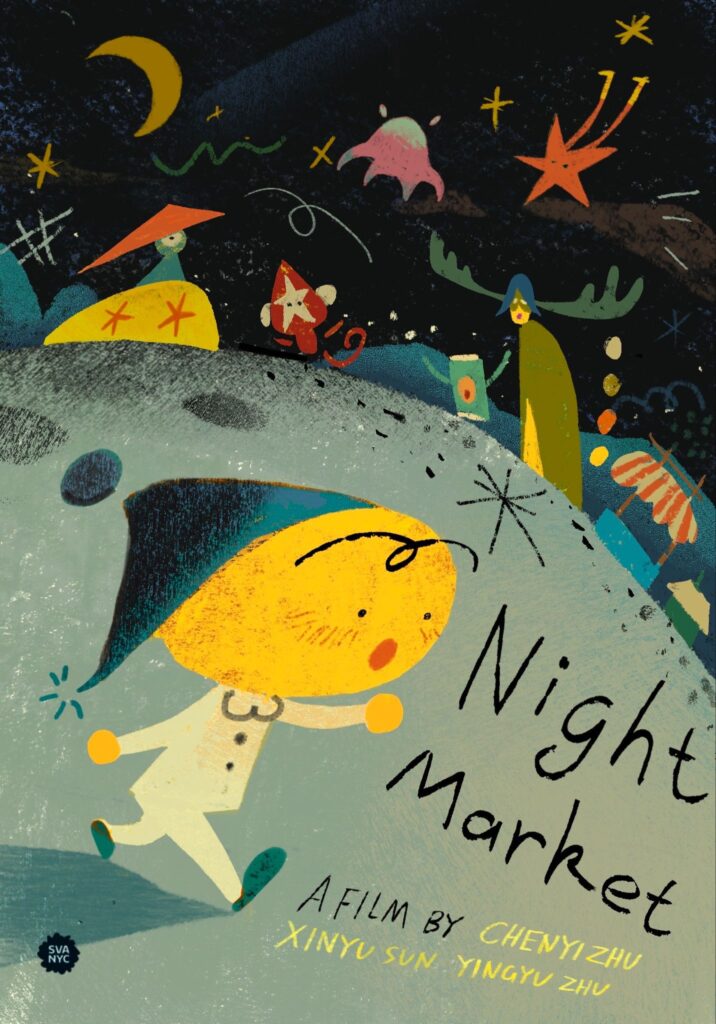
In the contemporary landscape of the North American animation industry, the relentless pursuit of hyper-realistic 3D rendering and the efficiency of AI-driven generation have become an almost irreversible “iron rule.” The industry often prioritizes technical perfection over the tactile warmth of the human hand. However, based in the heart of New York’s creative epicenter, animator and visual artist Chenyi Zhu is launching a gentle yet powerful rebellion against this industrial coldness with her evocative 2D animated short, Night Market.
Zhu possesses a formidable classical foundation and a visionary’s eye for contemporary storytelling. She has already demonstrated exceptional prowess in the commercial creative sector—most notably as the Founding Designer for the trend-setting brand PinPaint. PinPaint operates at the vanguard of creator economy and has picked up significant momentum as a brand bridging indie artists and consumer goods. Beyond the commercial domain, it is her work as an independent “auteur” that has truly announced her arrival on the global stage.
Currently, Night Market is gaining recognition on the international film festival circuit, including official selection at the Oscar-qualifying Chilemonos International Animation Festival in Chile, official selection in the Short Films for Children program at Fest Anča International Animation Festival in Slovakia, and selection in the International Competition of Short Animations for Children at the Zlín Film Festival in the Czech Republic, among others. In this seminal work, Zhu expresses her creativity in two intertwined dimensions: a meticulously crafted visual atmosphere and a narrative core designed for profound psychological healing. This unique approach has earned high praise from industry experts; during its official screening at the IndieJúnior Porto film festival, the committee highlighted its artistic and social value, stating: ‘With dreamlike visuals and heartfelt storytelling, Night Market highlights the importance of mental health and resilience for young patients.
Part I: The Visual Dimension—Resisting Industrialization Through the Soul of the Stroke
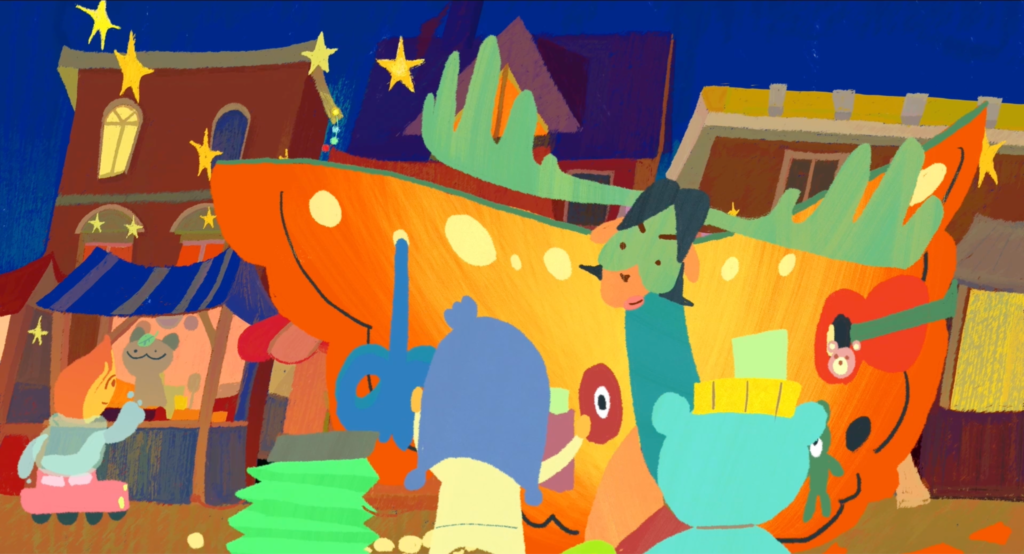
The overall visual atmosphere of Night Market is an exquisite paradox: it is fantastic and whimsical, yet underscored by a haunting sense of melancholy. To achieve this, Zhu remained steadfast in her commitment to traditional frame-by-frame hand-drawn animation—a labor-intensive process that many modern studios have abandoned in favor of digital shortcuts.
“In this work, the city’s nocturnal vistas and the diverse, eccentric monster vendors are the focus of our visual expression,” Zhu explains. Eschewing the sterile, “perfect” lines of vector-based digital tools, Zhu deliberately retained the texture of colored pencils and the “roughness” of hand-drawn strokes. This choice of tactile material is a sophisticated directorial strategy. It serves to simulate a “childlike, innocent perspective,” allowing the audience to witness the dreamlike transformation of an otherwise mundane urban landscape into a realm of wonder.
The visual language of Night Market is further enriched by deep-seated motifs of the Eastern philosophical paradox, “Zhuang Zhou Dreams of a Butterfly.” Throughout the film, the young protagonist is guided by fluttering butterflies,a metaphor where life may be as fickle and fleeting as a butterfly in a dream, the freedom of the spirit remains eternal. The colored pencil textures act as the physical manifestation of this philosophy, grounding the dream in humanly and fragile feelings.
Part II: The Narrative Core—Reconstructing the “Monster” Metaphor to Suture a Fractured Childhood
If the frame-by-frame hand-drawn technique constitutes the flesh and blood of Night Market, its profound psychological narrative serves as the film’s skeletal structure.
The film tells the story of a young girl battling cancer who escapes the confines of her hospital ward through a window, embarking on a journey through a nocturnal city. As she moves, the previously desolate streets are instantaneously illuminated, and a bustling night market populated by various “monsters” appears out of thin air.
The emotional epicenter of this imaginative tale stems from Zhu’s own private grief. Her close friend from middle school tragically passed away from leukemia. In Zhu’s memory, even during the most grueling stages of her illness, her friend maintained an unwavering optimism. As a tribute to this spirit, Zhu decided to construct a “dream” on screen for all children facing similar fates—a sanctuary where pain is replaced by play.
During the screenwriting phase, Zhu conducted extensive academic research into the cognitive world of pediatric oncology patients. She learnt that children suffering from long-term chronic illness often experience a severely weakened “self-concept.” These children frequently depict themselves as “fragmented” beings with missing body parts, or they project their self-image onto various “monsters.” They feel incomplete, residing in a state of profound psychological isolation and alienation from the “healthy” world.
In Night Market, Zhu achieves a brilliant directorial subversion of this trauma. In her phantom city, the “monsters” are no longer incarnations of fear or deficiency; instead, they are portrayed as exuberant and welcoming characters. This shift in perspective serves a therapeutic purpose, allowing the child protagonist—and by extension, the audience—to see the “monster” not as a mark of illness, but as a gateway to a vibrant, inclusive community.
Conclusion: Art as Social Intervention
As the film reaches its climax, the sky begins to brighten, and the bustling night market and its vendors gradually dissolve. The camera pulls back to reality, revealing the little girl still asleep in her hospital bed. It becomes clear that the entire odyssey was a “beautiful and gorgeous dream,” born from her singular, desperate desire for the freedom to play.
However, this dream is far from a mere illusion; it is a manifestation of immense psychological power. Through Night Market, Zhu has demonstrated not only her mastery as a first-rate animation director and visual strategist but also her capacity for meaningful social intervention. By utilizing gentle colors and a resolute narrative, she provides a voice of encouragement to every child in a hospital ward: do not fear the world outside those walls.
Zhu’s work reminds us that while the body may be confined by the harsh realities of medicine, the spirit remains an uncharted territory of infinite possibility. Her achievement lies in her ability to bridge the gap between art and human empathy. As she continues to lead branding efforts and visual storytelling in New York, Zhu stands as a beacon for a new generation of animators—those who use their pens not just to draw, but to heal, to suture the fractures of the human experience, and to remind us that in the realm of the spirit, we can all be whoever we wish to be.